Writing
Research notes on neural decoding, model evaluation, and learning movement.
ANN–BNN
Where learning lives in artificial and animal learners: a prior, an inference made in state, and a write into structure. One conditioning instrument, one ideal observer, and a week of pre-registered runs on the write channel.
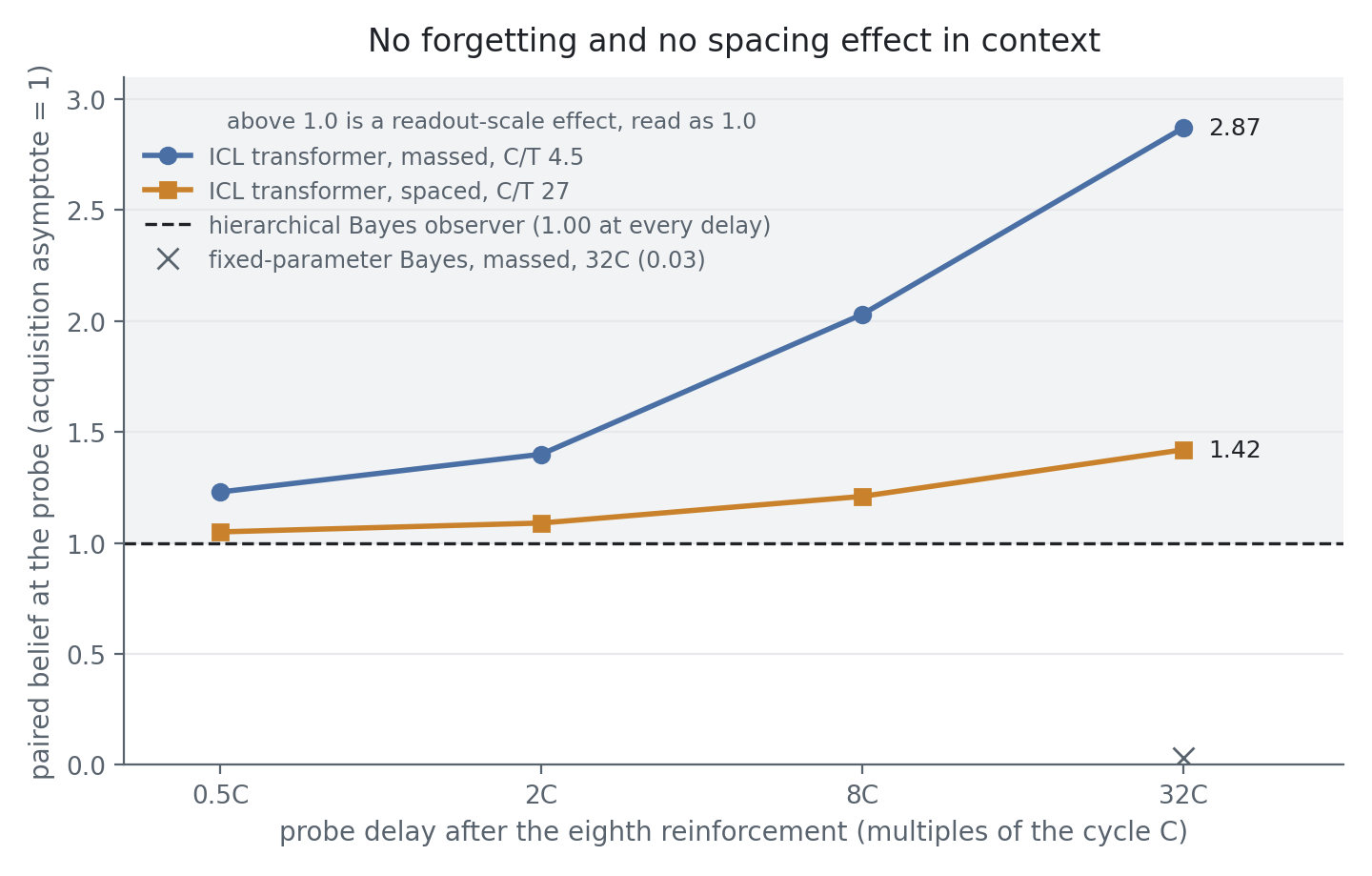
Where learning lives: prior, inference, write
Every learner is three things: a prior it starts with, an inference it makes in state, and a write that makes the inference permanent. The laws animals and in-context learners share live in the second; the differences live in the first and third. A retention probe on a meta-trained transformer gives the inference-only signature, once its reference is read honestly.
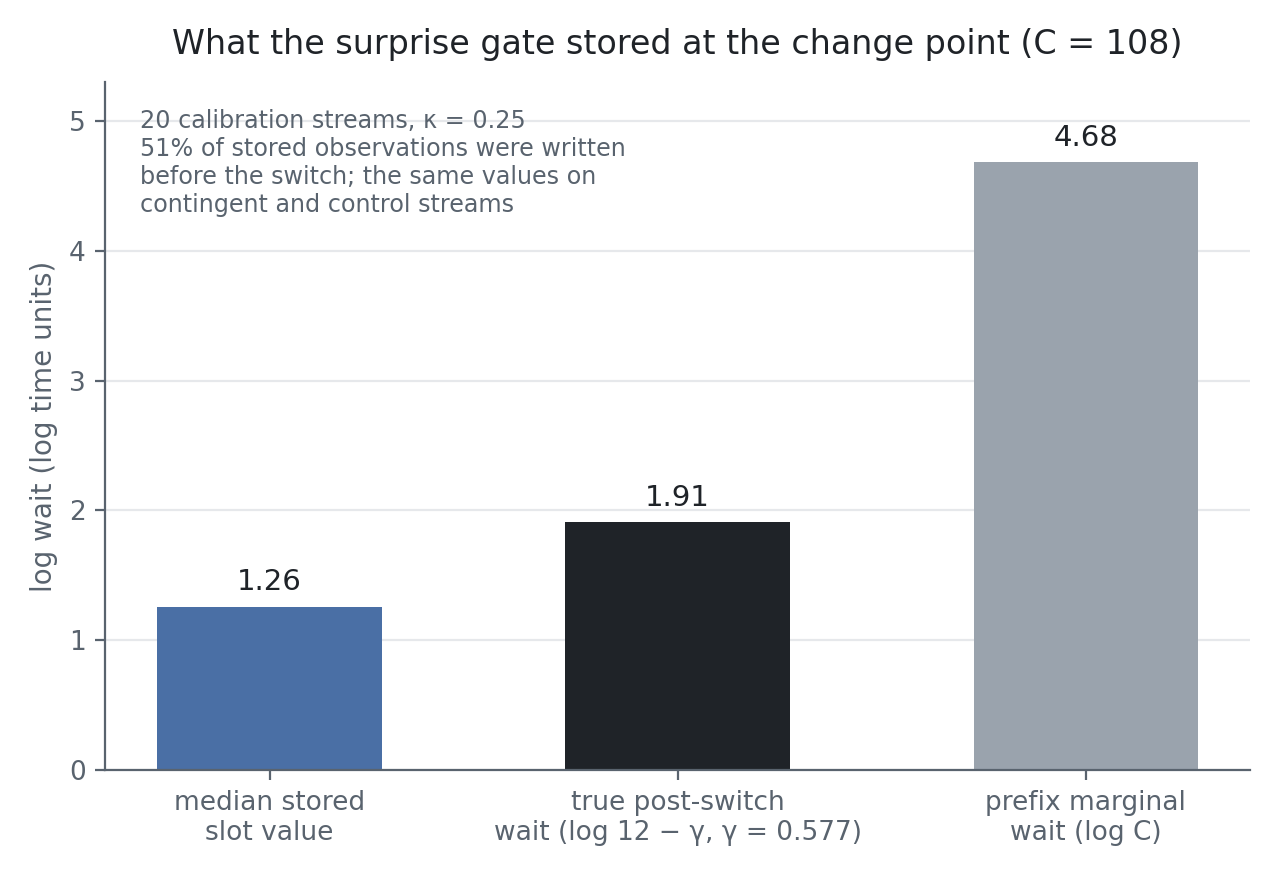
Eight hashed runs on the write channel, and what a gate outcome closes
A week of pre-registered tests asking whether a surprise-gated write channel adds anything an in-context prior lacks. Every prediction file was hashed before scoring; every gate stayed where it was; the predictions were never scored, eight times, and the eighth run explained the other seven.
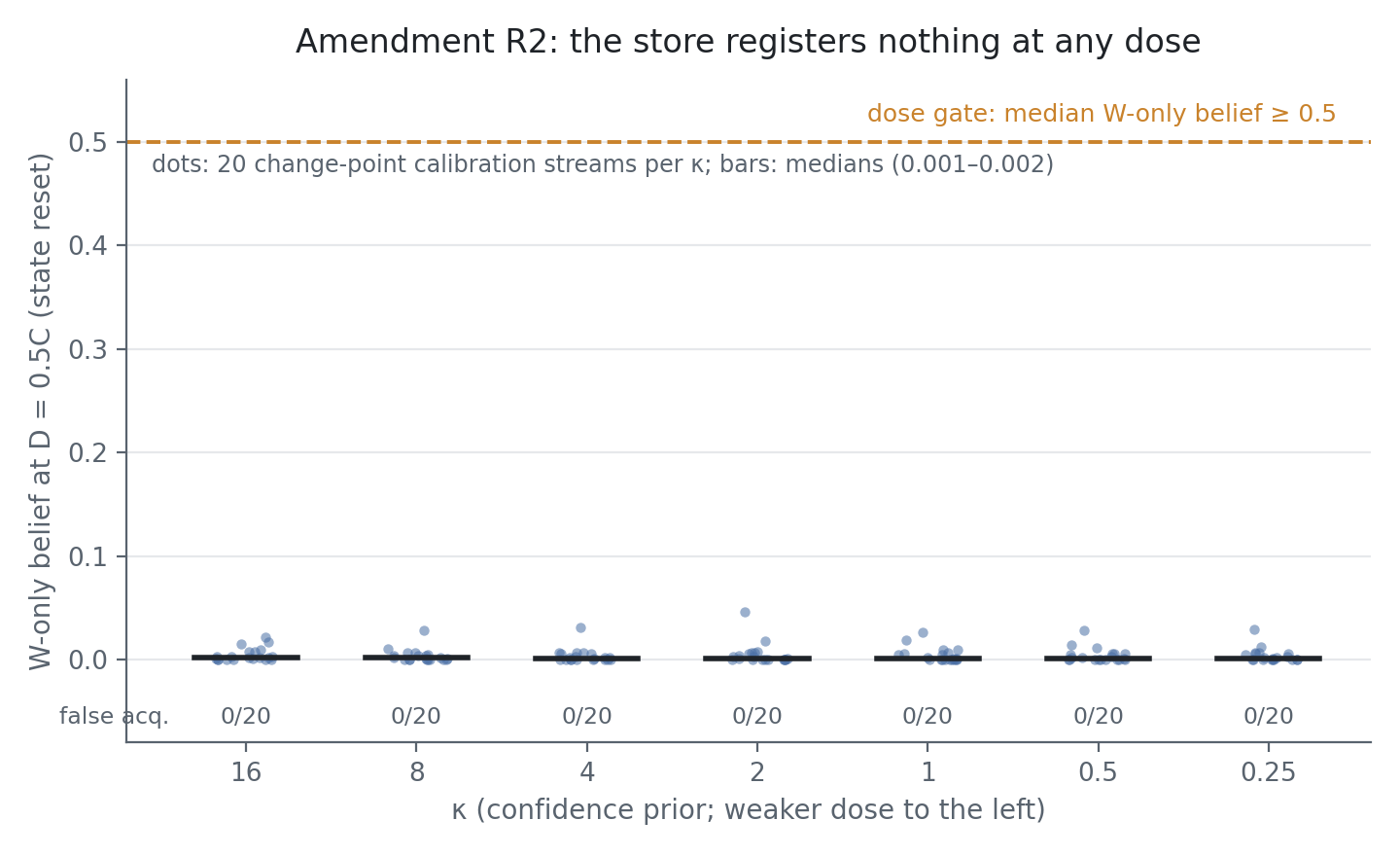
The surprise gate is a biased sampler
A write channel gated on prediction error never opened where the meta-trained prior was good. Moved to streams where the prior is wrong, it wrote, but only chance-short waits, the same on signal and control: half the store filled before the change point, and the stored value sat at 1.26 log units against a true 1.91. The exploratory diagnostic that closed the error-surprise gate as an operationalisation and named its replacement.
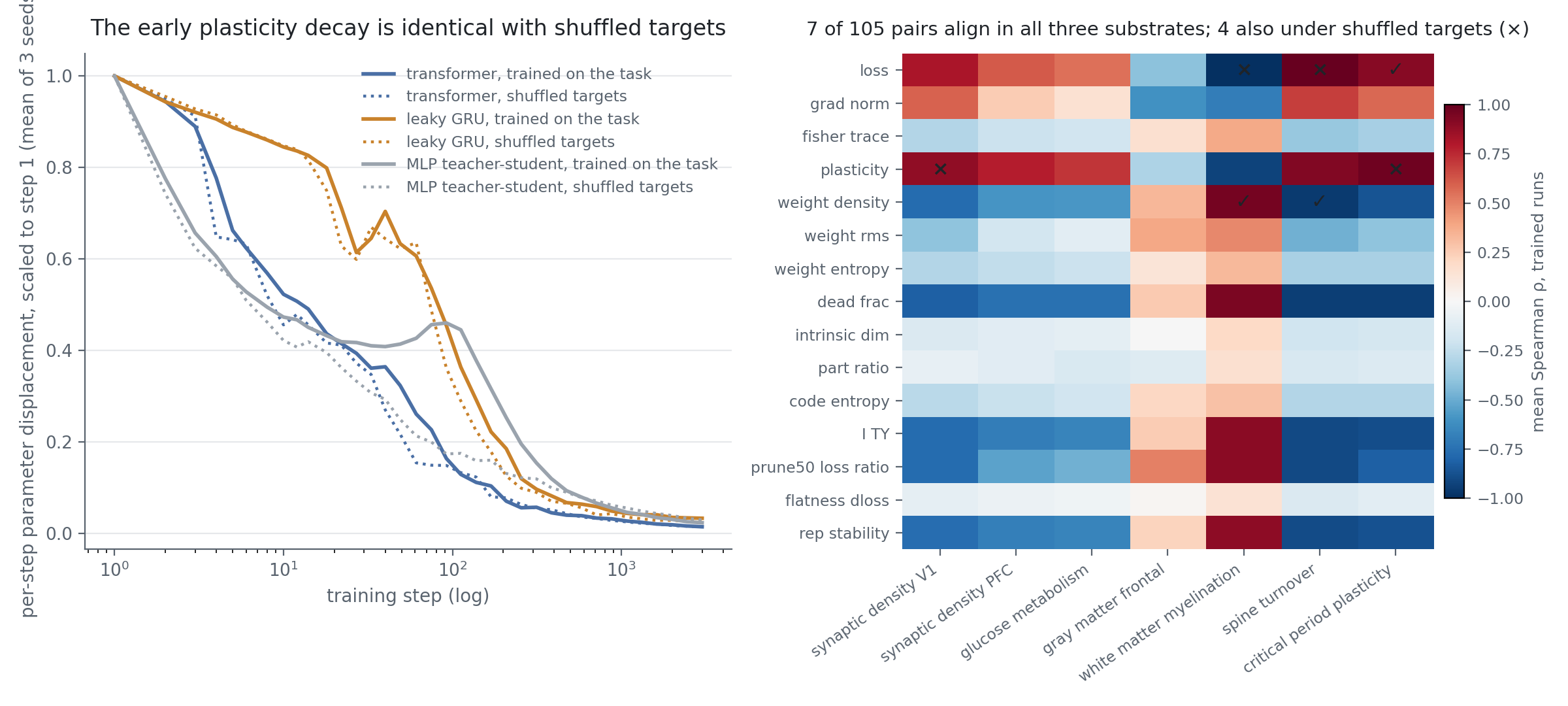
Every curve looks like development
Fifteen training-trajectory metrics on three small networks against seven reconstructed developmental curves: 7 of 105 pairs align in every substrate, four of them also under shuffled targets, and all seven are a monotone or decaying curve against another. The battery's own shape classifier reported an early inverted U that review traced to a filled-in missing value. A shuffled-target control should be mandatory for any claim of this kind.
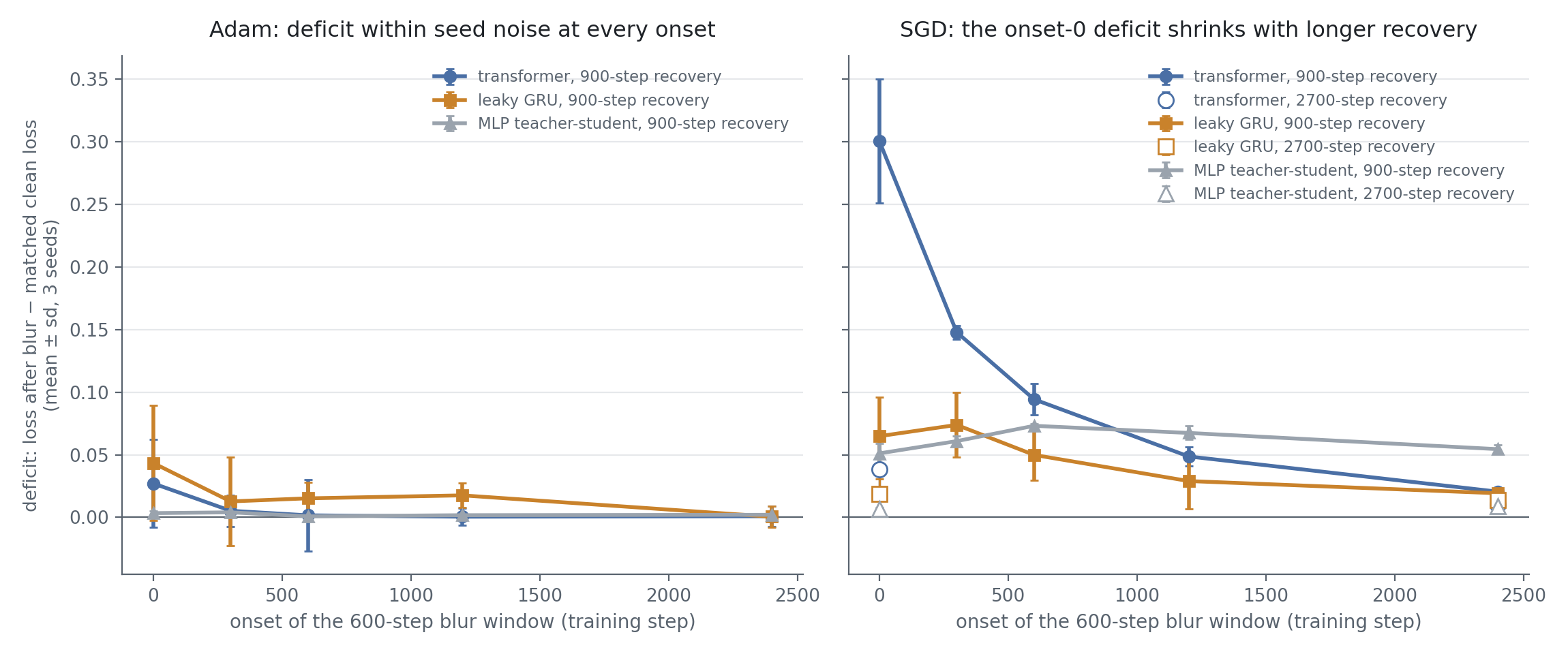
No critical period in a small network
A 600-step input deficit at five onsets, on three small networks under Adam and SGD. Under Adam the deficit is within seed noise at every onset. Under SGD it is largest at onset 0 and shrinks eightfold when recovery is tripled, from 0.30 to 0.038 on the transformer, still positive in all three seeds and still falling: recovery-limited on the evidence, not shown to be zero. What Achille's convnets add that these runs did not.
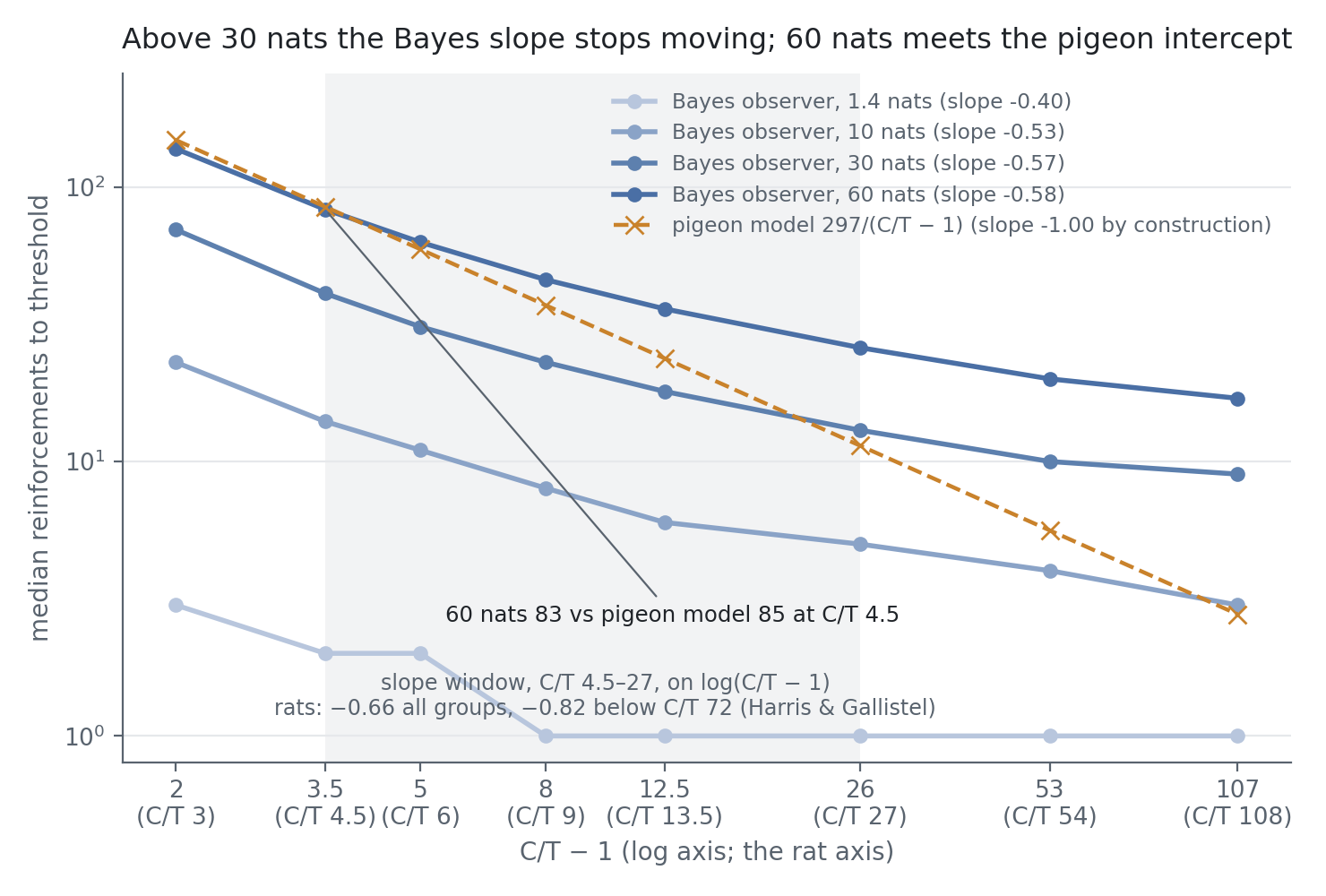
Sixty nats
An ideal rate observer's trials-to-threshold slope on the animal axis, log(C/T − 1), stops moving above about 30 nats, at −0.57 to −0.58 over C/T 4.5 to 27, against −0.66 for rats across all groups and −1 by construction for the one-parameter pigeon model. At 60 nats it also lands on the pigeon intercept, 83 trials against 85 at C/T 4.5. One fitted parameter, one free prediction.
ARC Prize 2026
Design notes from both ARC Prize 2026 tracks: why a solver that only proves cannot cover the tasks, why one that only guesses cannot know when it is right, and the layered architecture that came out of building both.
Neither a prover nor a guesser
What two ARC Prize 2026 tracks taught me about generalization: a solver that only proves cannot cover the tasks, a solver that only guesses cannot know when it is right, and the architecture has to carry both.
Static puzzles: a generator and a verifier
How the ARC-AGI-2 entry was built: a test-time-trained language model for coverage, a sandboxed program verifier for truth, and the measurements that put the handoff between them.
Interactive games: an agent that acts, checks, and remembers
How the ARC-AGI-3 entry was built: a language-model policy wrapped in deterministic guards, a scheduler derived from the score function, and a memory that carries a solved level's rule forward.
LibriBrain
Decoding heard words from MEG for the LibriBrain 2026 competition, in five posts read in order: the technical results, how the ideas came together, what the private leaderboard changed, a timing control that keeps the word onsets, and the MEG background treated as an equation.
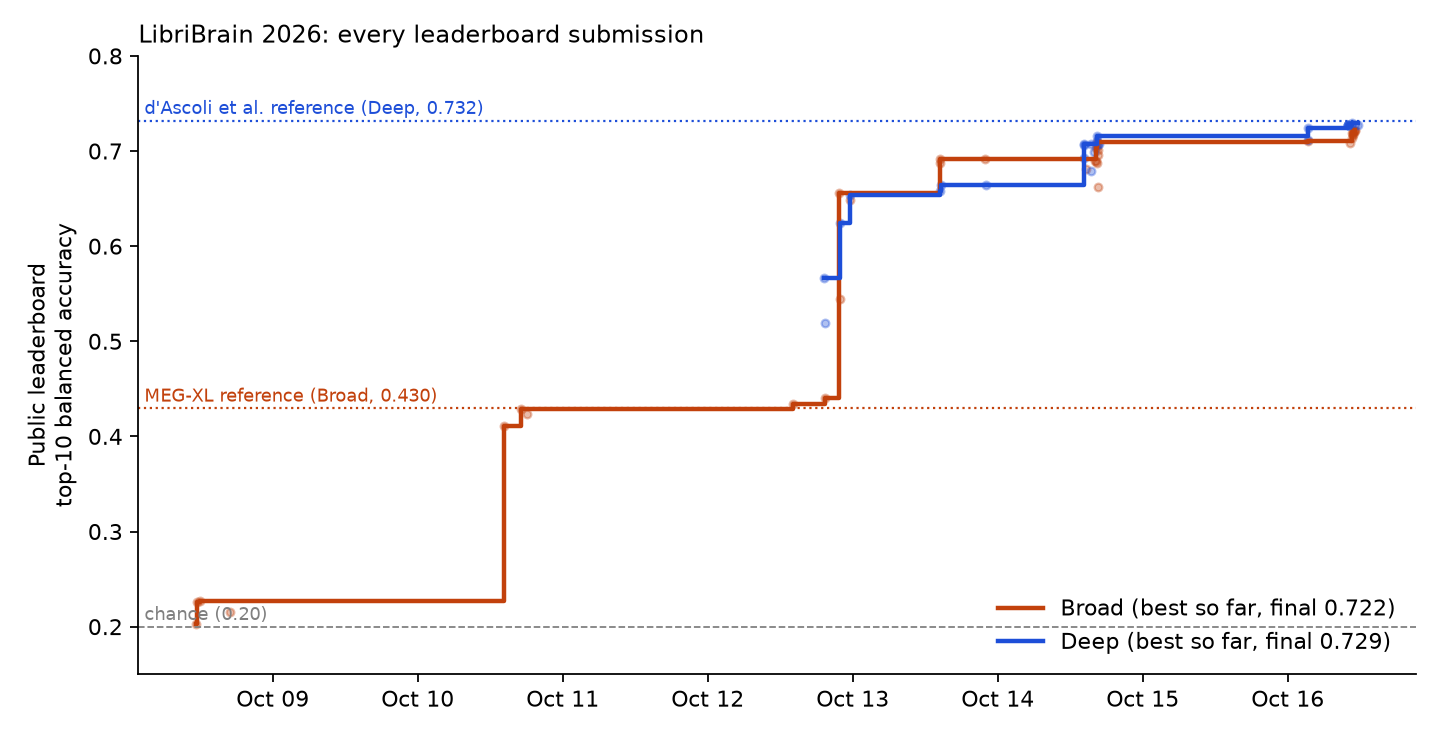
What timing reveals about MEG decoding benchmarks
Technical notes from LibriBrain 2026: contextual training targets, cross-subject transfer, test-time adaptation, and a timing-only baseline that changes how decoder scores should be interpreted.
Building my LibriBrain speech decoder
How I developed the LibriBrain entry: changing the training target, transferring across listeners, testing sentence-level context, and evaluating shortcuts under competition constraints.
Eighth in public, seventeenth in private
What the LibriBrain private leaderboard did to my final standing, which interventions survived the second split and which reversed, and what that implies for choosing final submissions.
The timing twin: a noise control that keeps the word onsets
Noise controls for MEG word decoding remove the onset-locked response that every real recording contains. A twin with synthetic onset responses, and a floor computed from event times alone, show how much a fixed window can learn from timing. With real background and the real onset response, timing accounts for about a fifth of the decoder's margin.
Noise as an equation
After LibriBrain I tried to treat MEG noise as a model to be learned instead of a nuisance to be averaged. Most of the results were negative, and they still say a good deal about where decoding gains can come from.
Philosophy
Essays on certainty, mind and consciousness, worked out from the texts and from my own experience.
Where Does Certainty Get Us? Moore's Hands and Our Dreams
Moore's hands, the appeal to common sense, and what our dreams leave standing.
The Baseline Is Part of the Claim
A brain decoder can score above chance by reading when a word occurred instead of which word it was. What it means for information to be in a signal, and why the baseline fixes the content of a decoding claim.