LibriBrain
Decoding heard words from MEG for the LibriBrain 2026 competition, in five posts read in order: the technical results, how the ideas came together, what the private leaderboard changed, a timing control that keeps the word onsets, and the MEG background treated as an equation.
Decoding heard words from MEG for the LibriBrain 2026 competition, in five posts read in order: the technical results, how the ideas came together, what the private leaderboard changed, a timing control that keeps the word onsets, and the MEG background treated as an equation.
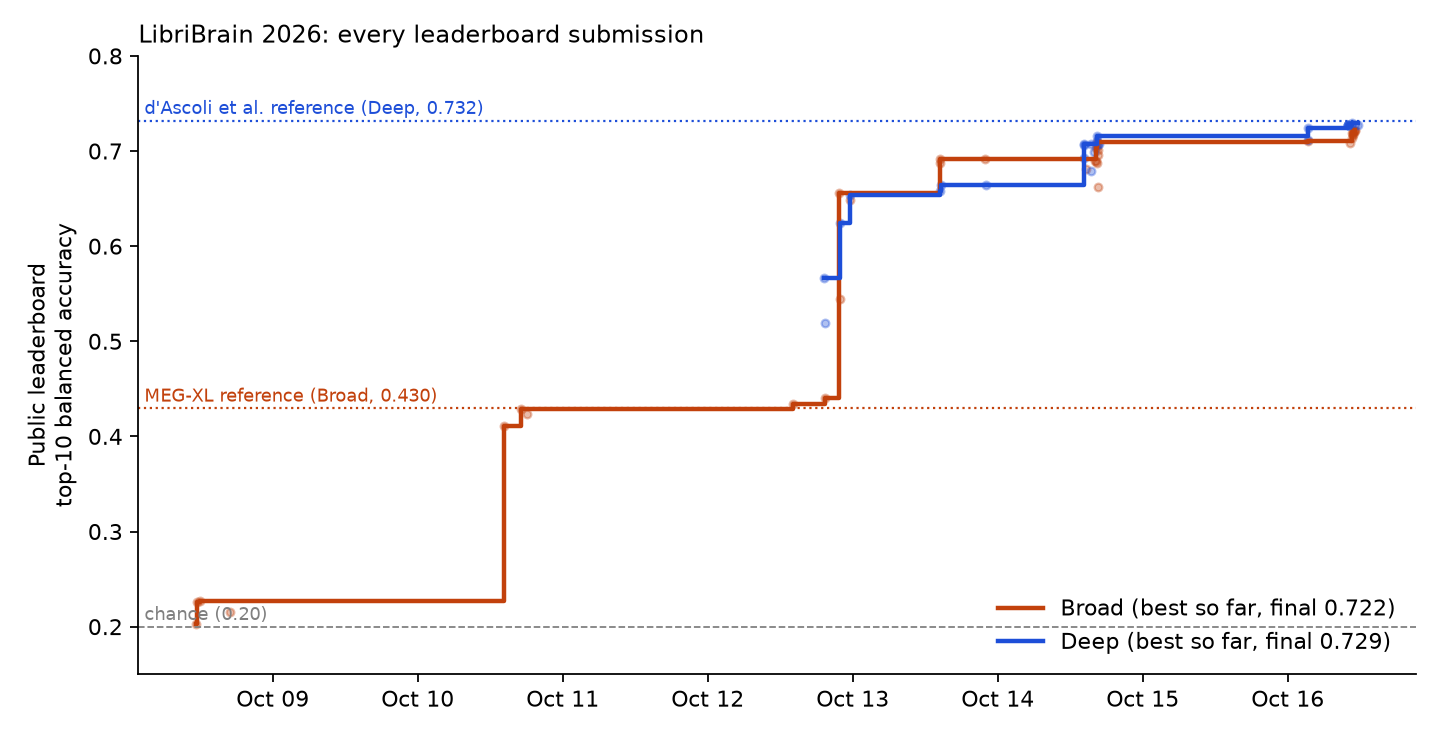
What timing reveals about MEG decoding benchmarks
Technical notes from LibriBrain 2026: contextual training targets, cross-subject transfer, test-time adaptation, and a timing-only baseline that changes how decoder scores should be interpreted.
Building my LibriBrain speech decoder
How I developed the LibriBrain entry: changing the training target, transferring across listeners, testing sentence-level context, and evaluating shortcuts under competition constraints.
Eighth in public, seventeenth in private
What the LibriBrain private leaderboard did to my final standing, which interventions survived the second split and which reversed, and what that implies for choosing final submissions.
The timing twin: a noise control that keeps the word onsets
Noise controls for MEG word decoding remove the onset-locked response that every real recording contains. A twin with synthetic onset responses, and a floor computed from event times alone, show how much a fixed window can learn from timing. With real background and the real onset response, timing accounts for about a fifth of the decoder's margin.
Noise as an equation
After LibriBrain I tried to treat MEG noise as a model to be learned instead of a nuisance to be averaged. Most of the results were negative, and they still say a good deal about where decoding gains can come from.