Part of the ANN–BNN series. Project page: Where an inference law lives.
Amendment R was the first of the write-channel runs to pass its dose gate. A content-keyed slot store on top of a frozen leaky GRU wrote on both kinds of stream (the shuffled control wrote on 8 of 8 reinforcements, the contingent stream on 4 to 4.5), but only the contingent stream acquired through the store: at the chosen dose (κ = 0.25) the shuffled control acquired on 0 to 2 of 64 seeds. Specificity was in what the store did to the readout, not in whether it wrote. What went wrong was the gate in front of it. The arm that wrote only when the prediction error was large wrote more under massed training than under spaced training, which is the reverse of what a surprise gate is for.
The reason is arithmetic rather than mystery. Surprise, as every error-gated rule defines it, is the frozen prior’s prediction error. The prior is a meta-trained network, and it is best exactly where the contingency is clearest. C/T 27 is inside its training range, and its prediction error there never crossed the gate’s threshold, so the gate never opened. For an animal the phylogenetic prior does not already contain the specific contingency, so every pairing is surprising. The boundary thesis of the first post applied to the write: a gated-write test is informative only on contingencies the prior does not already know.
Moving the test to where the prior is wrong
Amendment R2 kept the substrate and changed the streams. Each stream now began with a non-contingent prefix, the cues of its first half circularly shifted so that cue and reward were unrelated, followed by a contingent half at the same C/T. The control shifted both halves. The meta-training streams had been stationary, so a change point is out of the prior’s distribution: during the prefix the prior should settle on the marginal wait, and the first contingent pairs after the switch should then be surprising. The predictions were hashed before any powered seed (sha256 prefix 25ef6daf, commit c28d1ff). A smoke test caught two design faults, a fixed-count snapshot that fell before massed re-acquisition and a count-based falsifier, and both fixes are disclosed in the addendum.
The precondition for scoring anything was the same dose rule as R. The dose here is κ, a pseudo-count in the store’s confidence, c = n/(n + κ): the smaller κ, the fewer observations a slot needs before its value is trusted. On 20 calibration streams at C/T 9, find the weakest κ at which the write-only readout (belief at a 0.5C probe after the hidden state is zeroed, so that only the store can carry it; “W-only” in the figure) reaches a median of 0.5 while the shuffled control acquires on at most 1 of 20.
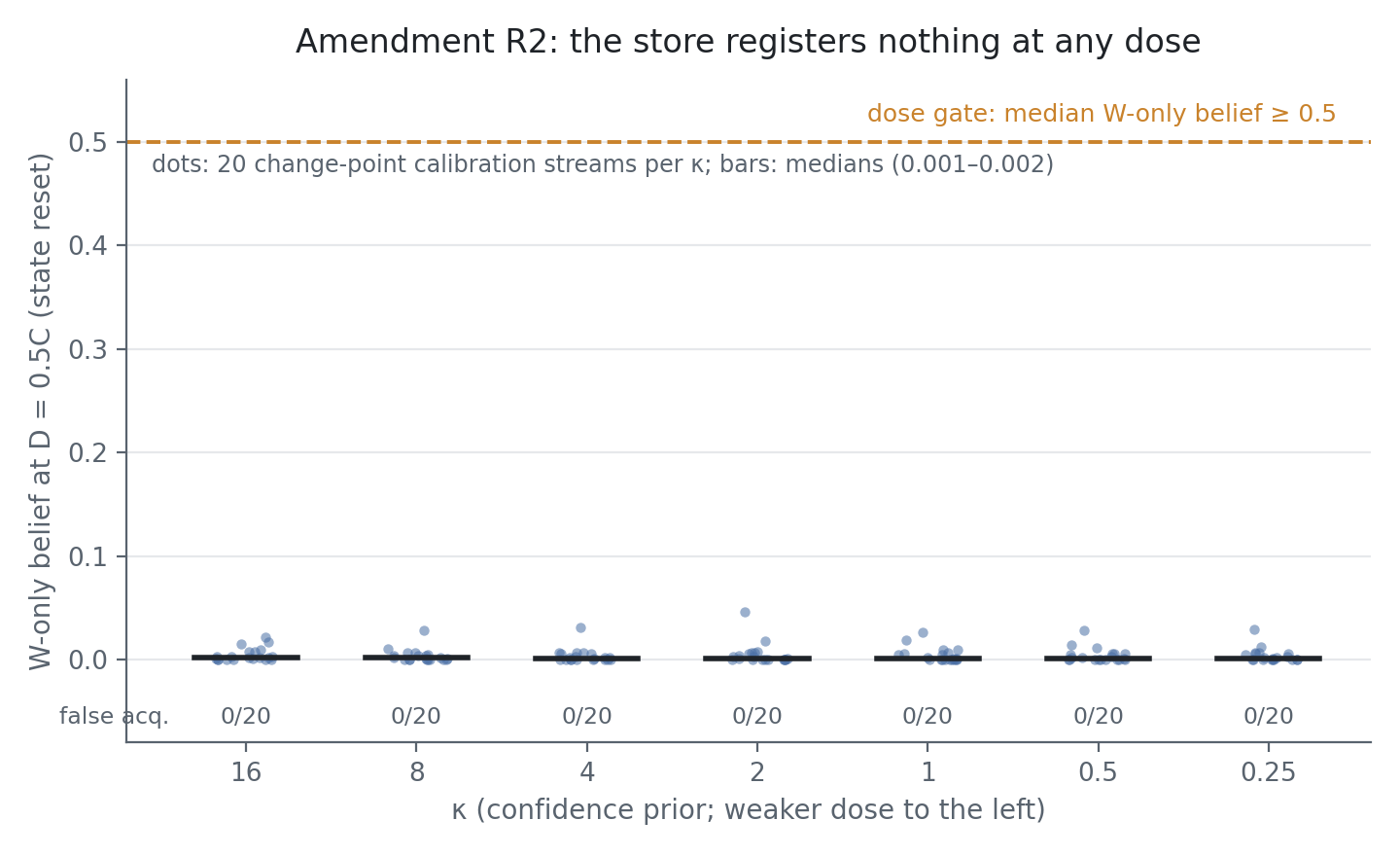
No dose passed. The median write-only belief was 0.001 to 0.002 at every κ from 16 down to 0.25, with a maximum single stream of 0.046, and 0 of 20 false acquisitions throughout. The failure is flat across the whole grid, so it is not a dose failure. The store carried nothing at the reset cue state that told the contingent stream from its control.
What the store held
The post hoc diagnostic (exploratory; 20 calibration streams at κ = 0.25) says why. The frozen prior’s own post-switch acquisition took a median of 41 trials. By the snapshot the store held two slots (the merge radius ρ = 0.9 folds nearly all cue states together) with a median of 20 observations, and 10 of those, 51 percent, had been written during the non-contingent prefix. The median stored value was 1.26 log units. The true post-switch wait is log 12 − γ = 1.91, where γ is Euler’s constant and the subtraction is the mean of the log of an exponential wait with mean T = 12. The prefix marginal is log C = 4.68, with C = 108 at C/T 9.
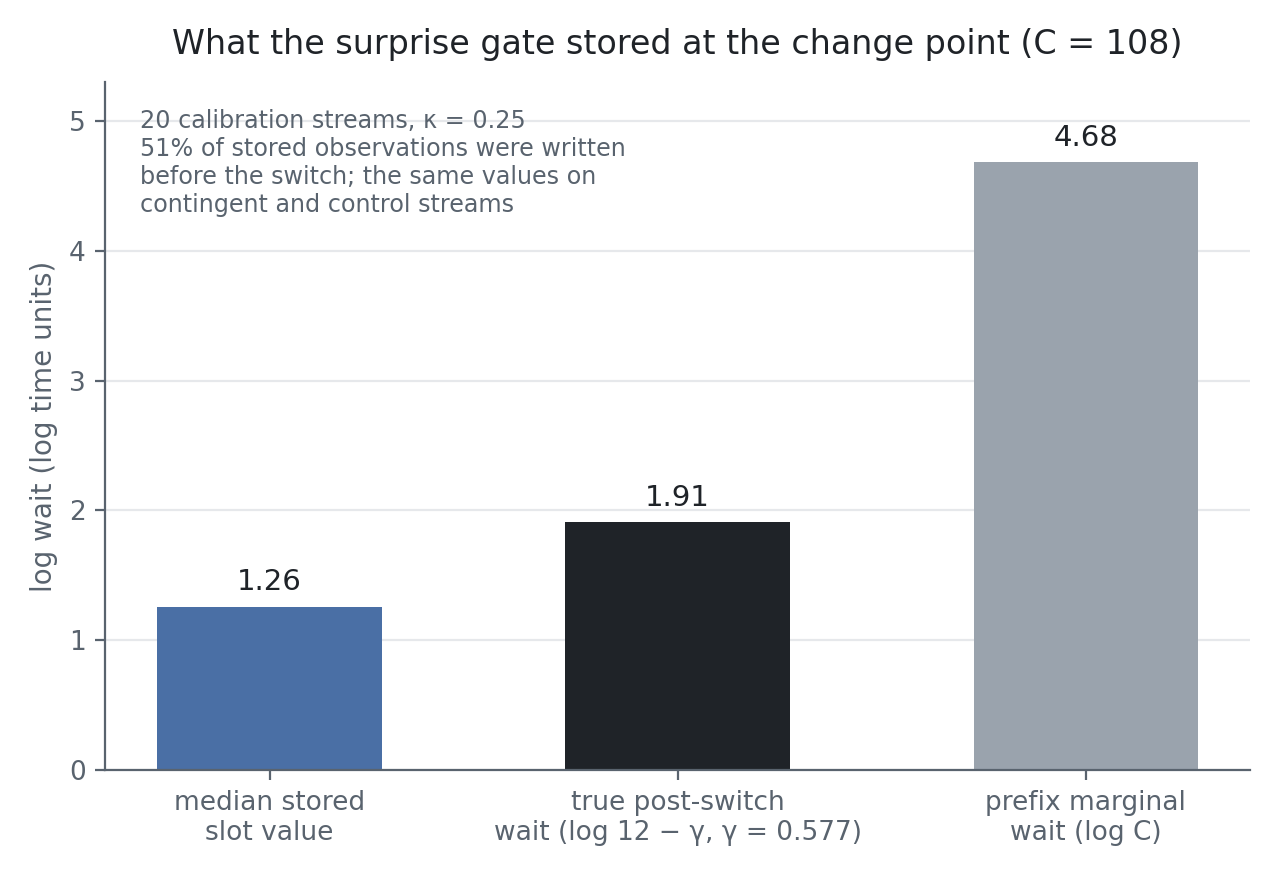
So the gate did fire during the prefix, and when it fired it stored a wait far shorter than either the background or the signal. On a non-contingent background the only surprising event is a reward that happens to land shortly after a cue. Those are exactly the events the gate admits, and nothing else. The writes are a selection-biased sample of the short tail of the background distribution, and because the control stream has the same background, the same tail gets written there. A running-mean store then carries the biased prefix value across the change point, and the contrast between signal and control vanishes. Whether an ungated write would have done better on these streams was not run; the hashed addendum predicted it would do worse, because an ungated store fills the prefix with slots keyed to wrong waits, so that comparison is open.
Both directions, two regimes
Put R and R2 together and the error-surprise gate has been tested in two regimes. Where the prior is good, prediction error is small and the gate is silent. Where the prior is wrong in the way a change point makes it wrong, prediction error picks out chance coincidences, and the gate is a biased sampler. By the frozen wording of the addendum the route is closed as an operationalisation. It was the sixth pre-registered run on the selection question and the eighth on the write channel, and the first of them to produce a mechanism rather than an under-dose. The third regime named after R, contingencies with C/T or T outside the meta-training range, was not run, and it is the one where the prior is wrong without being wrong about a change.
The outcome is labelled by its instrument: a frozen leaky GRU, a cue-keyed slot store with a running-mean update, a hard gate on squared prediction error, and change-point streams of 512 events. It is not a claim about neuromodulatory gating in animals. What it does say is that “write when surprised” is underspecified until you say surprised relative to what, and that relative to a good prior the answer is the wrong set of events.
What it points at
The diagnostic names the replacement. The quantity that changes at the change point is not the prediction error, which spikes on coincidences; it is the inference arm’s own belief, which moves once and stays moved. A write gated on the change in that belief would be silent during the prefix, where the belief is flat at “no contingency”, and would fire once at the switch. Pair it with slot replacement rather than running means, so that a value written before the switch does not survive it. That is a write gated by inference rather than by error, which is what the decomposition said from the start. It is the next hashed file, and it has not been run.