Part of the ARC Prize 2026 series. The argument this engineering supports is in Neither a prover nor a guesser. Project page: ARC Prize 2026.
ARC-AGI-3 replaces the puzzle with a game. The agent receives a sixty-four by sixty-four frame of coloured cells and a small action vocabulary: a handful of discrete actions, a click on a coordinate, and a reset. Nothing tells it the goal, the controls, or the win condition. Each game has several levels, and the hidden competition set is a different catalogue of games from the public one, so a hard-coded strategy for a known game is worthless. The run happens inside a nine-hour notebook on a single large GPU, with a local model server and no internet, across on the order of a hundred games at once.
Start from the score function
Before touching the agent I re-derived the scoring rule from the official package and reproduced every game score in my local runs to six decimal places with my own implementation. Each completed level earns the square of the ratio between a human baseline action count and the agent’s actions, capped a little above one; levels are weighted by their index, so later levels are worth more; unfinished levels sit in the denominator at zero; and a game’s score is pinned at the fraction of weighted levels completed. The competition score is the mean over games.
Two consequences fall out. Depth dominates. In a full local run across the public catalogue, action inefficiency cost less than half a point in total; the entire spread between games came from how many levels were cleared. The marginal level is worth more the deeper you are. Clearing a game’s fourth level is worth twice its second, which means the agent should keep investing in games it is already progressing on, and the scheduler can be a formula rather than a heuristic.
That formula is the first deterministic layer. The priority score for each game combines its current completion fraction, the value of its next level, its recent rate of progress, and a tail fade that de-prioritises games that have stalled, normalised so that games on different level counts compete fairly. The policy decides what to do inside a game; the schedule decides which game gets the next slice of a limited concurrency budget. Mixing the two would mean asking a language model to reason about a formula it cannot see.
The policy, and the guards around it
The policy is a quantised open-weight model, served locally and prompted with the frame, a diff against the previous frame, the available actions, and a running conversation. It writes small analysis programs against the frame, reasons about what changed, and chooses an action. This is the probabilistic layer, and left alone it does three expensive things: repeats an action that changed nothing, walks back into a board state it has already seen, and keeps spending actions on a level it has effectively lost.
Each of those is a deterministic fact the environment can state exactly, so each gets a deterministic guard:
- a no-op block refuses to resubmit an action that did not change the board from the current state;
- a stale-state block hashes frames and refuses to re-enter a state already visited on this level;
- a batch block stops a multi-action batch at the first action that changes nothing;
- a reset policy restricts resets to level boundaries, where they are free, rather than letting the model use them as an undo;
- a first-action warm-up sends one reset straight to the engine so the platform’s liveness rule is satisfied while the model server is still loading.
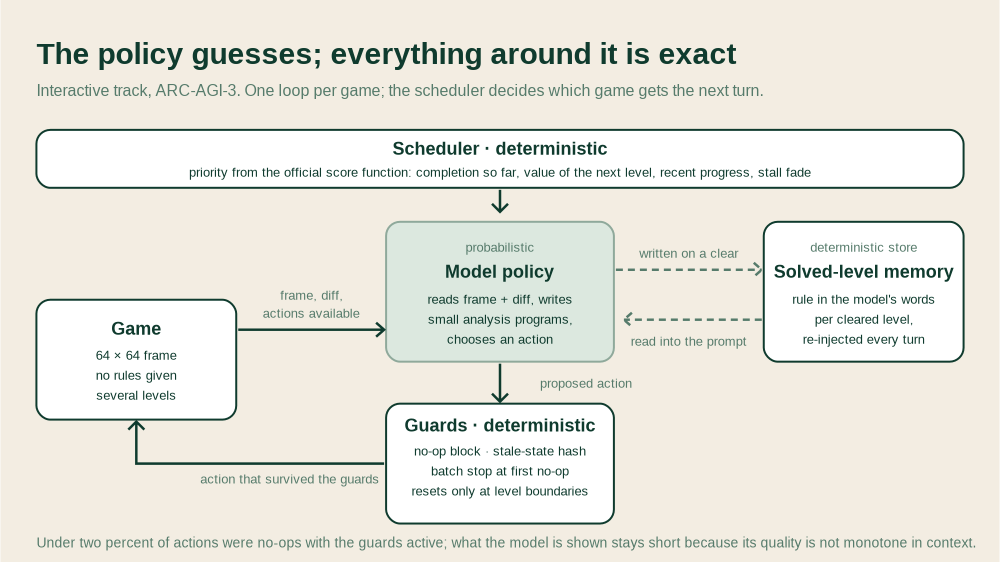
Measured on a full local run with the guards active, under two percent of all actions were no-ops and the longest run of them in any game was three. That is the guard layer doing its job, and it is also the reason I did not pursue richer undo mechanics: there was no waste left for them to recover. The remaining cost was elsewhere, in actions spent on levels that never closed, which is a scheduling problem, not a guard problem.
Memory that is written by the model and read by the system
The most interesting layer sits between the two halves. When the agent clears a level, the rule it believes it discovered is useful on the next level of the same game and on later levels still. But the conversation that held that reasoning gets trimmed as the context fills, and a long game runs well past the point where the context has to be drained.
The solved-level memory keeps a short block per cleared level: the rule in the model’s own words and the last stretch of actions that worked. The block is written by the probabilistic layer and stored by the deterministic one, and it is re-injected into the system prompt on every turn rather than only when a trim happens, because a block that waits for a trim never reaches a game that does not trim. In the full local run every long game crossed the drain threshold, so this is the path that matters on the hidden set. I also measured what the memory should not contain: replaying a level’s winning clicks from the next level’s first frame cleared nothing, so the memory stores the rule and the shape of the solution, not the literal action list.
Reading frames the way the rule is written
The offline analyses that fed the prompts were about structure in frames. On one public game, the cells a click could toggle formed a lattice of three-by-three blocks at a fixed stride, the cycle lengths of those toggles were constant within a level and changed between levels, and the clicks that solved each level sat at lattice centres. A detector for that structure is deterministic: classify every cell by its colour path under a probe click, group cells into blocks, read the centres. What the model contributes is the hypothesis about which structure to look for and what to do with it, and that is the right division. The system should extract regularities exactly, and the model should decide what they mean.
The same shape held for the context budget. Level clears per hundred actions fell as the prompt grew past sixty thousand tokens, but later levels are harder and are reached at larger contexts, so the measurement is confounded. The honest conclusion was a design preference rather than a fix: keep the deterministic summary of a game small and keep the model’s working context short, because the policy’s quality is not monotone in how much it is shown.
What the entry is
- a public, well-engineered harness for serving the model and running the official benchmark, forked and extended;
- a scheduler derived from the score function rather than from intuition;
- deterministic guards around every action, measured to remove nearly all wasted moves;
- a solved-level memory written by the model and re-injected by the system;
- a start-up path that enters the benchmark before the model server is fully loaded and relies on a long retry grace, so a slow weight load costs time and not games;
- a commit path that rehearses on the public games and a scoring path that is never gated on a flag the platform may not set, with a hard refusal to write a placeholder result on a scoring run.
That last item is the one I would tell anyone entering a code competition: the path that scores must be the path you rehearsed, with no branch that can silently choose a shortcut.
What comes next
The two open levers are both at the boundary between the layers. First, a within-level measurement of context length against actions-to-clear, so the confound above can be resolved and a context-trimming policy can be chosen on evidence. Second, moving more of the frame analysis into the deterministic layer as named detectors the model can call, so that its reasoning starts from extracted structure rather than from pixels.