Part of the ARC Prize 2026 series. The two tracks are written up in Static puzzles: a generator and a verifier and Interactive games: an agent that acts, checks, and remembers. Project page: ARC Prize 2026.
The Abstraction and Reasoning Corpus is built so that the rule behind every task is new. You see two or three demonstrations of a transformation on small coloured grids, and you have to apply the same transformation to a grid you have never seen. In the 2026 edition there are two tracks: ARC-AGI-2, where the task is a static input-to-output mapping, and ARC-AGI-3, where the task is a game you have to play without being told the rules. Both are designed to defeat memorisation. Training data cannot contain the test rule, because the test rule is chosen to be absent from it.
That design turns ARC into a question about architecture rather than scale. I spent the competition building both extremes of the answer to their limits, measuring where each one stopped, and putting the two together where they stopped. This post is the argument that came out of it. The two track posts hold the engineering.
Two honest ways to be wrong
A deterministic solver treats a task as a search for a program. It parses grids into objects, proposes candidate transformations from a typed grammar, solves the free parameters against the demonstrations, and keeps only programs that reproduce every demonstration exactly. When it answers, it is right for a reason you can print. When it is unsure, it abstains. In the frozen hold-out runs of my grammar and local-rule solvers, the wrong-answer count was zero every time. That precision is real and it is the property every later layer depends on.
Its failure is coverage. A grammar can only name transformations whose vocabulary it already contains, and the vocabulary that counts is not operations but objects. When I measured why the rigid-motion family abstained on the training distribution, the limiting term was not the motion model and not compute. In more than half of the development outputs, the connected components in the output were simply not the components in the input. The task had created, merged, or reconceived objects, and a solver whose atoms are the input’s objects has nothing to move. Adding operators does not fix that, because the missing piece is the parse, and a richer parse is a bigger search space with the same thin signal to prune it.
A probabilistic solver treats a task as a conditional distribution. The strongest public approach to ARC-AGI-2 is a four-billion-parameter language model fine-tuned on grid tokens, then adapted at test time to each task on its own demonstrations, decoded under sixteen symmetric views of the grid, with candidates ranked by how consistently they score across those views. It almost always produces something. On a one-hundred-and-twenty-task proxy set, the candidate pool contained the correct grid for well over a third of the outputs.
Its failure is that it does not know. Ranking by cross-view agreement is a proxy for truth, not truth: on the same proxy set, roughly one correct answer in six that was sitting in the pool was ranked out of the two allowed attempts, and I could not find a reweighting of the views that recovered them on held-out task halves. Worse, when the right grid is absent from the pool there is no signal at all that it is absent. The model is equally fluent about a wrong answer. Every improvement in selection is bounded by generation, and generation is bounded by what a fixed-size model can be nudged into with a few gradient steps.
The two failures are complementary, and that is the whole point
Line the limits up and they do not overlap.
| Deterministic layer | Probabilistic layer | |
|---|---|---|
| Produces a candidate | rarely (abstains) | almost always |
| Knows when it is right | yes, by replay on the demonstrations | no, only by agreement |
| Fails by | silence | confident error |
| Scales with | the parse vocabulary | model capacity and test-time adaptation |
| Cost of a wrong answer | zero (it did not answer) | a wasted attempt |
A system that commits to one column gives up the other column’s strength, and ARC is scored on both. You need coverage to have any chance, and you need verification to spend your two attempts on candidates that can be right. Doubling down on the deterministic side means writing ever larger grammars to chase a parse problem that has no closed form. Doubling down on the probabilistic side means accepting that the selector is a vote, and a vote among symmetric views of the same wrong guess is unanimous.
The hard stance in either direction is a bet that the other column is unnecessary. The benchmark is constructed so that it is not.
What the hybrid has to look like
The architecture I converged on has deterministic and probabilistic layers in alternation, and the interface between them is the design.
- Deterministic perception. Canonicalise under the eight dihedral symmetries and colour permutations, build a shared palette across demonstrations so colour roles line up, extract connected components, match input objects to output objects with an assignment that allows creation and deletion. This layer does not guess. It gives both halves a common vocabulary.
- Probabilistic proposal. A model adapted to the task on its demonstrations proposes outputs, and separately proposes programs in a small grid language that a sandbox can execute. Proposal is where coverage comes from, and it is allowed to be wrong.
- Deterministic verification. Every proposed program is replayed on every demonstration in a sandboxed interpreter with a whitelisted syntax tree, memory and time limits, and shape and colour checks on the result. A program that misses any demonstration is rejected, and the first mismatch is returned as a message.
- Probabilistic repair. That message goes back to the proposer as context. A failed program is not discarded; it is the most informative prompt available, because it says exactly which demonstration broke it.
- Deterministic selection order. A verified program outranks any unverified grid. Among unverified grids, consistency across symmetric views breaks ties. Both attempts are filled, and they are filled with different kinds of evidence.
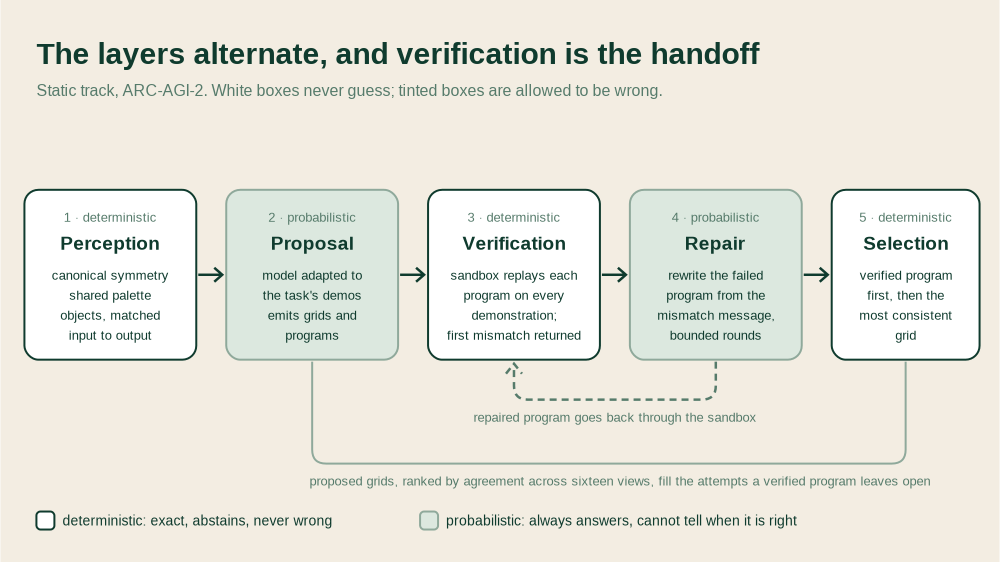
Notice that the strongest neural pipelines already rely on deterministic structure: dihedral augmentation is a hand-written symmetry prior, test-time training is exact-match supervision on the demonstrations, and the candidate ranker is a consistency check. Conversely, every useful symbolic system needs a learned proposal distribution, because the space of programs even in a small language is far too large to enumerate at the depth real tasks need. Neither camp is actually pure. The disagreement is only about where the handoff sits, and my claim is that the handoff should sit at verification: let the probabilistic layer be as generous as it likes, and let the deterministic layer be the only thing that is allowed to say this one is right.
The same shape in the interactive track
ARC-AGI-3 looks different and is not. An agent is dropped into a game with no rules text, and the score depends on how many levels it clears and how few actions it spends. The probabilistic layer is a language model deciding what to do next from the frame. Left alone it repeats actions that change nothing, re-enters states it has already visited, and burns the action budget on levels it has lost. Each of those is a deterministic fact about the environment: a frame hash is or is not new, an action did or did not alter the board, a level is or is not already solved. So the guards are deterministic, the policy is probabilistic, and the memory that carries a solved level’s rule into the next level is a deterministic record written by a probabilistic author. The scheduler that decides which game gets the next slice of compute is a formula, not a prompt, because the score function is known exactly and a formula can optimise it.
How I worked
Every claim above came out of the same procedure. Write the hypothesis and the threshold before the run. Freeze the solver, hash the file, score once on a hold-out that was never opened during development. Report the term that limited the result, not the metric that looked best. The practice is slower than tuning on the evaluation set, and it is the only reason I can say which layer failed on which tasks rather than that a number went up or down.
The competition entries themselves were built on strong public pipelines for each track, extended with the verification and guard layers described here, and submitted under the one-notebook-per-day rules. What I am keeping is the architecture, because it is the part that transfers.
What comes next
The next unit of work is the parse. The deterministic layer abstains when the output’s objects are not the input’s objects, and the probabilistic layer is weakest on exactly those tasks, so a learned proposer for object correspondence, verified by replay, is the highest-leverage piece that neither layer has today. After that: a verified-program leg that runs inside the competition time budget, with repair prompts built from the sandbox’s mismatch messages, and a selection rule that treats a verified program as a different kind of evidence from a vote.