The LibriBrain 2026 competition, run by the PNPL group at Oxford, asks a narrow question about magnetoencephalography. Given the magnetic field recorded while a person heard a word, which of 50 words was it? The words are almost all function words (the, was, not, they), and a prediction counts if the true word is among its ten best guesses, so chance is 0.20. The Deep track has one listener with about 80 hours of recordings. The Broad track has 39 others, most with ten to forty minutes of labelled data and seven with none.
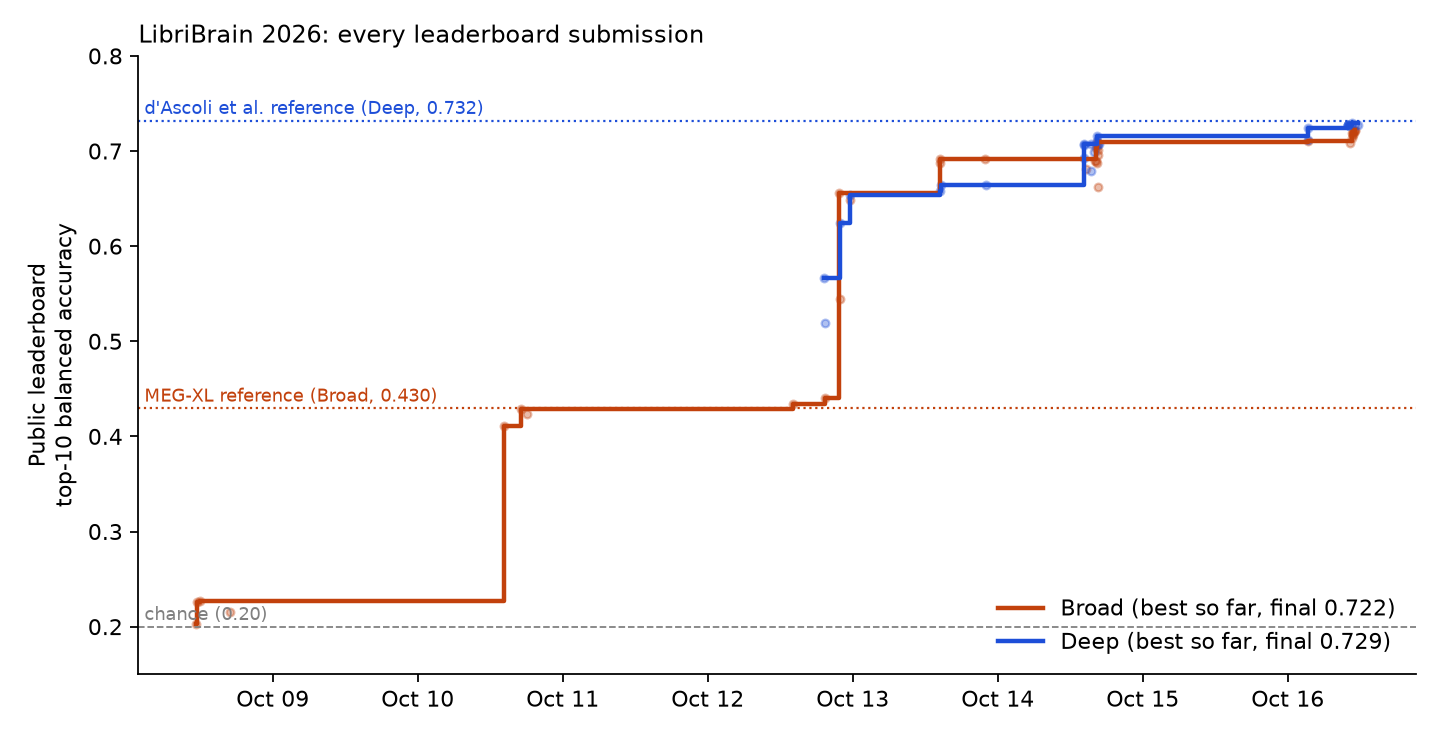
The entry finished at 0.722 on Broad and 0.729 on Deep on the public leaderboard, eighth on Broad. The published references were 0.430 (MEG-XL, pretrained on roughly 300 hours from 800 people) and 0.732 (d’Ascoli et al., supervised on all of the Deep subject’s data). Everything ran on one 8 GB GPU over 26 days, and every experiment was written down with a predicted effect before it was run.
What moved the score
Two changes did most of the work. Training the encoder to predict the contextual embedding of each heard word, taken from a large text model (T5-large, encoder block 12), carried Broad from 0.23 to 0.43. Then, against expectation, training on the Deep subject alone and transferring with no adaptation took Broad from 0.43 to 0.66. Adding the Broad subjects’ own short recordings made transfer steadily worse: 0.632 locally with none of their data, 0.452 when it made up half of each batch.
The rest came from structure in each subject’s own unlabelled test rows. Balancing each subject’s predicted class mass added 0.036 on Broad. A bigram grammar learned by expectation-maximisation from the subject’s 156 test sentences added 0.018. On Deep, re-estimating normalisation statistics on the test recording day added 0.044, because that day was absent from training; the same step hurt new brains. No computation ever combined rows from different subjects, which is the leak the organisers prohibited.
The stimulus can decode itself
The first sentence-level model was given the time between words. It reached 0.51 locally, and with the timing removed the same model scored 0.29, no better than having no sentence context at all. It had learned word identity from durations in the audio, not from the brain. I removed the feature, though the rules allowed it.
After the competition I measured how far timing alone goes. A classifier that sees no MEG at all, only each word’s relative onset, the gap to the next word, its position and the sentence length, scores 0.632 on the same held-out blocks where the brain decoder scores about 0.70 to 0.78. This establishes a strong non-neural baseline on the tested split. Decoder performance therefore needs to be compared with timing-only models as well as chance.
When local validation failed to transfer
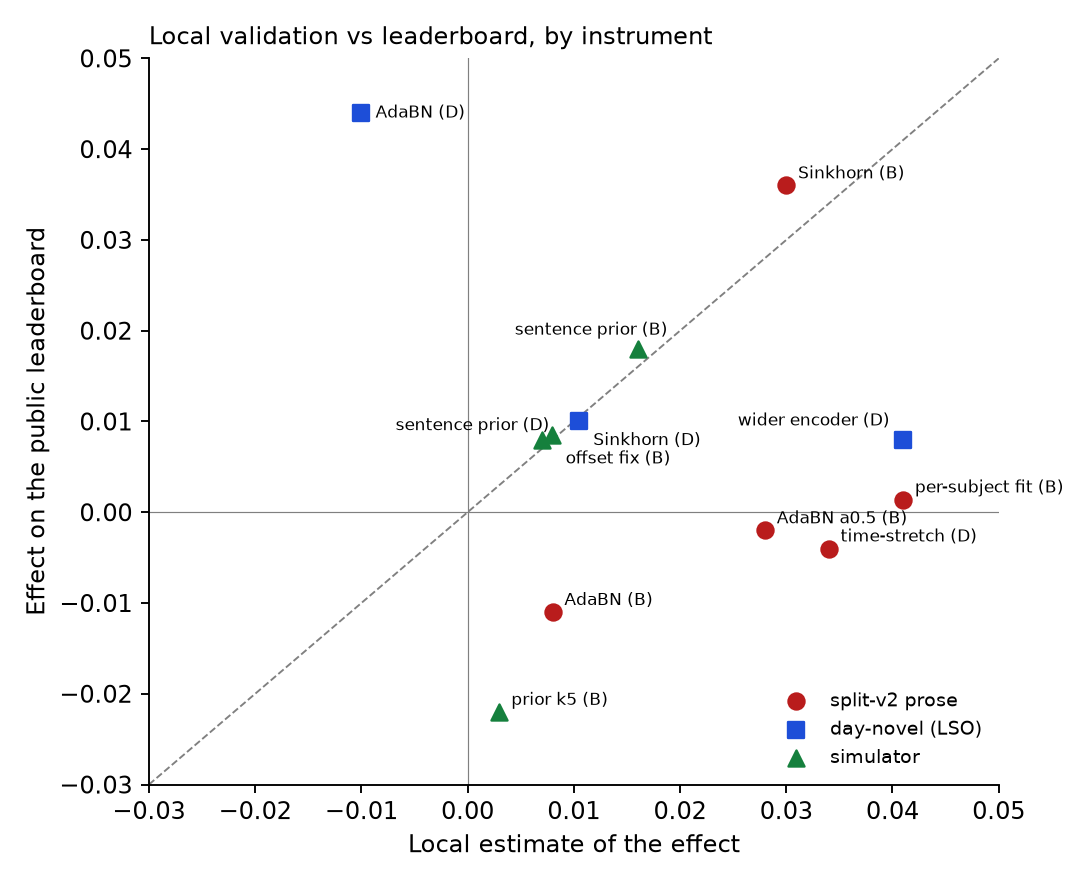
Several changes looked certain locally and did nothing on the leaderboard. Fitting a per-subject input layer on each Broad subject’s labelled data improved local accuracy in all 18 configurations tested and added 0.001 on the leaderboard. Time-stretch augmentation helped the Deep subject in both of two seeds and lost on the leaderboard. In every case the local test held out part of the same recording session used for fitting. A simulator built from real held-out predictions and constructed sentences, calibrated against leaderboard effects, tracked the leaderboard far better.
Where it stopped
Averaging a subject’s predictions over repeated hearings of the same word, using labels to group them, adds 0.14 with four hearings and 0.22 with sixteen, so the information exists in aggregate. Without labels those repeats cannot be found: same-word trials are no more alike than different words in every raw representation tested. The limit is the evidence a single hearing of a single word leaves in the sensors. Over the last two days, 164 post-processing ideas were screened against the simulator, and none moved that.
A write-up of the evaluation lessons (the timing floor, shared test sentences across subjects, validation that shared a recording day with training) is in preparation.
Code and results: github.com/rohit-ravi2/libribrain-2026